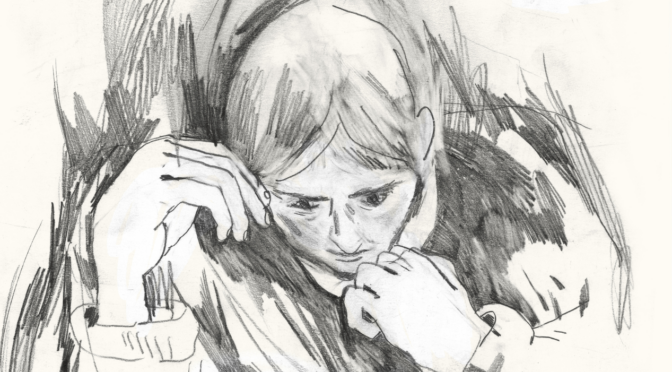
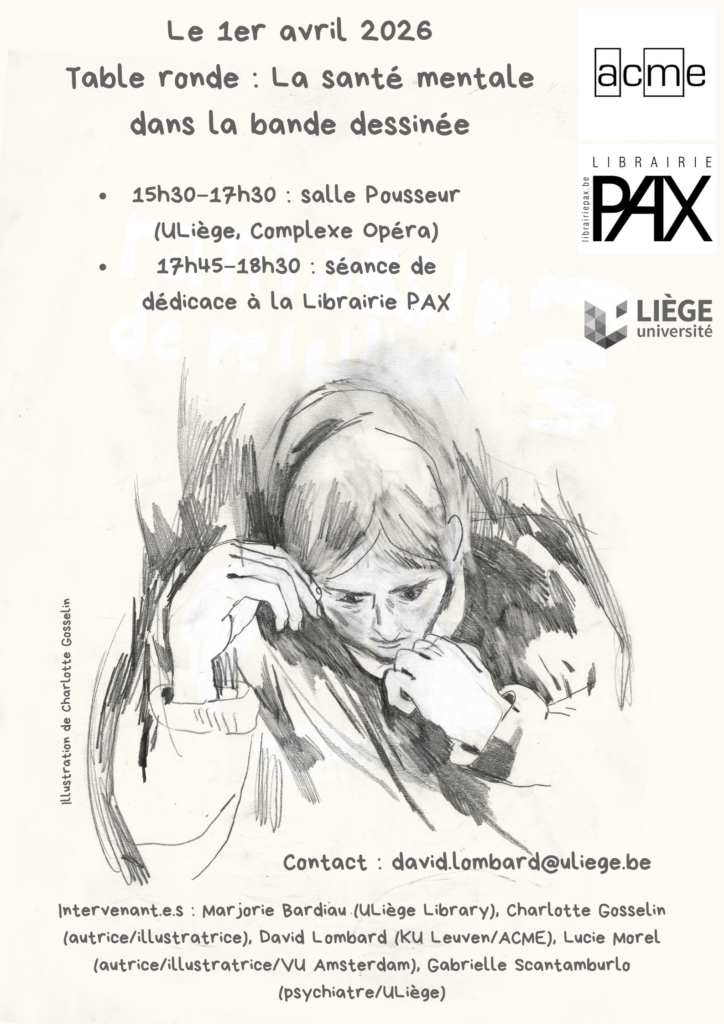
Dans un monde où les représentations de la santé mentale méritent d’être à la fois empathiques, créatives et rigoureuses, la bande dessinée émerge comme un médium singulier pour penser, voir et ressentir ce qui échappe souvent aux mots seuls. Cette table ronde propose d’explorer avec nos intervenant.e.s les avantages et les limites de la bande dessinée comme forme de représentation, d’enseignement, de sensibilisation et d’intervention autour des questions de santé mentale, en mobilisant des perspectives artistiques, esthétiques, psychiatriques et pédagogiques. Continuer la lecture de Table ronde – La santé mentale dans la bande dessinée→
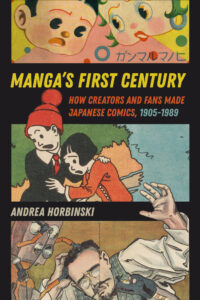
Manga’s First Century: How Creators and Fans Made Japanese Comics, 1905-1989
Book talk by Andrea Horbinski
Thursday 27 November 2025 – 18:00-20:00
Université libre de Bruxelles, Campus du Solbosch, salle Baugniet (Bâtiment S)
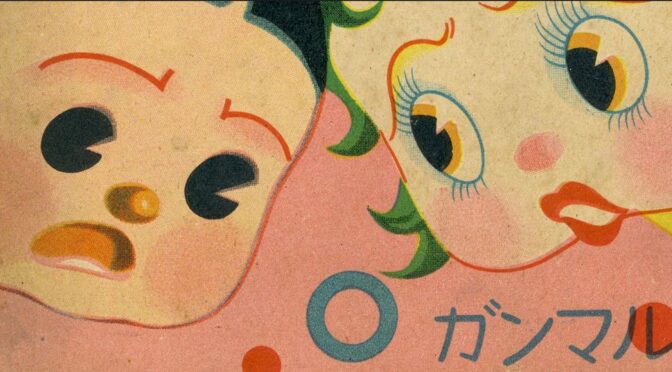
In Manga’s First Century: How Creators and Fans Made Japanese Comics, 1905-1989, Andrea Horbinski explores the rise of manga as a distinct medium in Japanese society in the 20th century. Beginning with the new use of “manga” to refer to high-collar political cartoons in the 1890s, she traces manga’s development across formats through newspapers, magazines, and books as creators sought to expand the medium in the face of challenges ranging from state repression under the imperial government to perpetual editorial stubbornness. Continuer la lecture de ACME Speaker Series – Andrea Horbinski→
Dès ses origines et tout au long de son histoire, la bande dessinée entretient des liens étroits avec les autres arts visuels.
Beaux-arts et bande dessinée relèvent-ils d’ailleurs de champs différents ou de pratiques distinctes ? Fécond, traversé de tensions et de malentendus, leur dialogue s’inscrit dans des catégorisations variables selon les aires culturelles, et qui se sont construites et reconfigurées au fil du temps.
Call for papers at the Royal Institute of Technology in Stockholm & Uppsala University, 22-23 April, 2026
Today, the field of comics is undergoing a profound transformation marked by a growing heterogeneity of forms, formats, and production processes. From synthetic comics, operational images, data-driven visualization to embodied, non-visual comics, comics are expanding beyond the conceptual and historical frameworks that have traditionally defined it. Existing models in research— grounded in the artisanal craft traditions, narratology, text-image correlation, and human-centered authorship— are struggling to account for this rapidly diversifying landscape.
Oscar Conti (Oski) was one of the most important Argentine cartoonists of the 20th Century. Born in 1914, deceased in 1979, his career spanned the most fertile years of the Argentinian comics industry. He was a cartoonist of an enormous popularity and prestige, profuse production, a frequently cited example of the artistic possibilities of the medium, as well as a political cartoonist. He published in Argentina, and also in Chile, Cuba, France, Germany, Italy, México, Perú, Spain and Venezuela. Continuer la lecture de ACME Speaker Series – Amadeo Gandolfo→
« Ceci n’est pas une personne »: On Jason Lutes’ Berlin (1996–2018) as a Stylistic Showroom
Thursday 23 May, 14:00 / KU Leuven, Van Den Heuvelinstituut (Dekenstraat 2, 3000 Leuven), leslokaal 01.65
During its more than two decades of serial publication and beyond, Jason Lutes’ Berlin has been used by a considerable number of authors pursuing an ‘abstract’ approach to comics, i.e., for illustrating the structures and possibilities of graphic narratives in general terms. These (in a broad sense) didactic uses of Berlin may be explained by the wide variety of its comics-specific elements. The work is a ‘stylistic showroom’ in that it borrows from a number of styles rooted in distinct traditions of 20th-century graphic narratives, employing a variety of different page layouts, text-image combination techniques, and smooth transitions between its different subplots. Continuer la lecture de ACME Speaker Series / Lukas Etter→
Digital comics encompass a variety of works, ranging from print comics that are then digitised or pre-published online to e-comics that resist print publication and have stronger affinities with videogames, animations, and other digital products. Online or offline, static or animated, reproducing the page format or expanding beyond the borders of a screen, digital comics always imply some degree of adjustment of processes and habits, because comics are also cultural objects, creative practices as well as models of production and consumption. Continuer la lecture de CFP — Comics Strike Back→
Fabrice Preyat, accompagné de ses collègues Olivier Koch (Université Nice-Sophia Antipolis) et Pablo Turnes, (Universidad de Buenos Aires/Alexander von Humboldt Foundation-Freie Universität Berlin), lance un appel à articles pour un numéro thématique de la revue quadrilingue Sur le journalismeconsacré au journalisme graphique et reportage en bande dessinée.
Ce volume de la revue Sur le journalisme, About journalism, Sobre jornalismo souhaite interroger les « alternatives » que représentent la bande dessinée de reportage en considérant ses singularités narratives et éditoriales, ses relations à la profession, et les stratégies industrielles dont elle dépend. Il entend, dans ce but, explorer le genre de manière interdisciplinaire en privilégiant trois axes distincts, impliquant des approches relevant tant de la narratologie post-classique et de l’analyse de discours que de la sociologie, des études sur les industries culturelles et de l’histoire des médias et du journalisme.
Image : Jeús Cossio – Conga. Vida y muerte en tiempos del extractivismo (2014)
Trauma, memory and history. The (re)construction of the recent past in 21st Century Latin American comics
26 November 2021 — 16:00 | ULB, Campus du Solbosch, Bâtiment A, Porte Z, 4e niveau, local 103 (salle de réunion) : A.Z.4.103
The Argentinian comics scholar Pablo Turnes will share an in-progress research project.
Project description
Since Maurice Halbwachs’ reflections, ‘collective memory’ has become an increasingly complex subject. How to tackle this issue from contemporary comics? Studies on memory and its representation in comics have been booming since the publication of Art Spiegelman’s Maus (1980-1991) and its impact on key memory studies scholars such as Marianne Hirsch, Michael Rothberg and Andreas Huyssen. These works were crucial to develop a reflection on how popular culture could contribute to new ways of grappling such complex historical events like the Shoah. Continuer la lecture de ACME Speaker Series — Pablo Turnes→
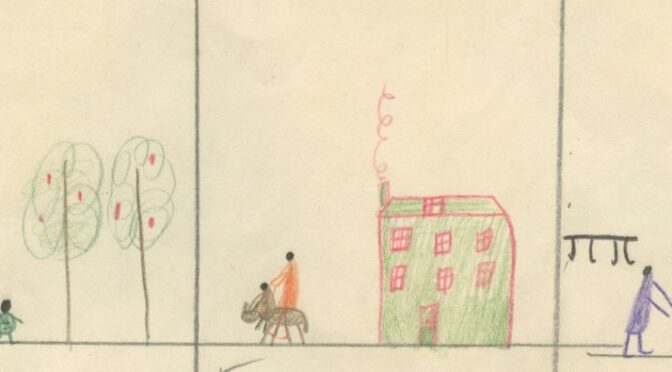
Image : « Le nin et le jéant » (sic.), bande dessinée de Colette Boermans à l’âge de 7 ans, Bruxelles, c. 1936.
Maaheen Ahmed et Benoît Crucifix lancent un appel à contributions pour une thématique de Comicalités portant sur le dessin d’enfant et la bande dessinée. Propositions à envoyer avant le 15 décembre 2021.